
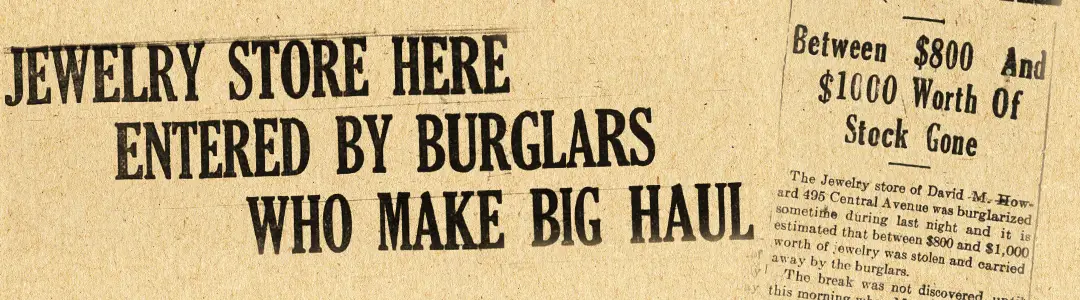
Some time during the night of Feb. 18-19, 1920, someone broke into the rear of the jewelry store owned by David M. Howard, located on Franklin (now the Upper) Square. The robbery was not discovered until the following morning when Howard opened the store for business and “found that the place had been ransacked”. Assistant Marshal Crowley investigated and located the point of entry.
“Jewelry of all kinds was stolen including diamonds, both silver and gold watches, gold watch chains and charms of various kinds, gold rings, and many other valuable articles,” the newspaper reported. Fosters also reported that “the officers have scarcely a clue upon which to work but they are investigating the case as best they can…”. The value of the take was estimated to be between $800 and $1,000, somewhere in the area of $15,000 in today’s money.
A detailed description of the items stolen was distributed to police departments throughout New England. No information turned up for several weeks. Then, on March 9, a man named Harry Deuth appeared at Howard’s store with a watch that needed repairs. The store clerk, Albert Allie, recognized it as one of the stolen items. (Within the same article, Fosters spells the last name as “Deuth”, “Deutch”, and misspells “Alie”. The paper’s proofreader must have been on vacation.) Mr. D then contacts the local police and tells them he “bought the watch of a boy”. This person was contacted, but because of his age, according to the article, “his name cannot be used in this story”.
But based on the information from “the boy” the police obtained a search warrant for 58 Atkinson St., the home of one Charles Pettis. A search turned up nothing related to the burglary, but the officers stayed around for the return of “the boy” from his place of employment—too young to be named in the article, but apparently not too young to have a job at the shipyard. He told them he had received the watch from a Joseph Cavanaugh who, until recently, had been a boarder at the Pettis house.
It just so happened, that on the prior Saturday, the Dover police had located and arrested Cavanaugh at a local watering hole, at the request of the Medford, Massachusetts, police department, where he was wanted on a charge of non-support. A Medford officer had traveled to Dover and taken Cavanaugh to Massachusetts, so Dover police now put in a call to Medford asking if they could have him back. The response was that upon his appearance there he had been released on bail, but a promise was given that he would be located and returned to custody. Late evening on the 8th the call came through. Cavanaugh had been found and had agreed to a voluntary return to Dover. His initial story was that he had nothing to do with the break-in at Howard’s store; he had purchased the goods from an unknown/unnamed male.
Earlier on the evening of the 9th, Charles Pettis had appeared at the police station to say that he had discovered a black leather bag in his attic which he assumed had been left there by Cavanaugh. Officers returned to the house, the bag was examined and found to contain gold and silver watches and numerous other items assumed to be part of the loot from Howard’s store. (Albert Alie came to the station on the morning of the 10th and identified the contents of the black bag.) The “boy” was questioned further, but denied he had been with Cavanaugh at the time of the break-in. It appears, however, that he was taken into custody based on the fact that he had possession of the stolen watch sold to Mr. Deuth/Deutch.
Once again, it is Assistant Marshal Crowley who makes the road trip to bring the accused back to Dover. Further inquiry showed that Cavanaugh had been in Dover since the previous November, working initially as a brakeman on the shipyard train between Dover and Portsmouth, but more recently employed at the Pacific Mills. He and Crowley discussed his situation while still in Medford, and he fessed up to having done the deed at Howard’s store. Further, he revealed that when the officers had originally gone to the house on Atkinson St. to arrest him at the request of the Medford police, he had “thrown a lot of the stolen jewelry out of a window of his room into the snow”. Crowley telephoned this information back to Dover, and officers made two trips, the second in the early evening with a searchlight, and managed to uncover numerous pieces of silverware, a bracelet, a gold-filled watch, and other items. “Cavanaugh made a clean breast of the burglary”.
He and Crowley returned to Dover “on the paper train from Boston”, very early in the morning on the 11th.
(To be continued)
Read Part 2 here.
Visit the Crimes Along the Cochecho for all stories released so far.
Anthony McManus is a Dover, New Hampshire historian whose column “Crimes Along the Cochecho” explores the darker chapters of local history. A Dover native and Boston College Law School graduate, McManus served as City Attorney for Dover (1967-1973) and held various public offices before practicing law until 2001. His extensive historical work includes the “Historically Speaking” column in Foster’s Daily Democrat and his 2023 book “Dover: Stories of Our Past,” released for the city’s 400th anniversary. Through research, writing, and public presentations, McManus continues to illuminate both significant events and lesser-known stories that enrich understanding of Dover’s colorful past.