
Missed Part 1? Start here.
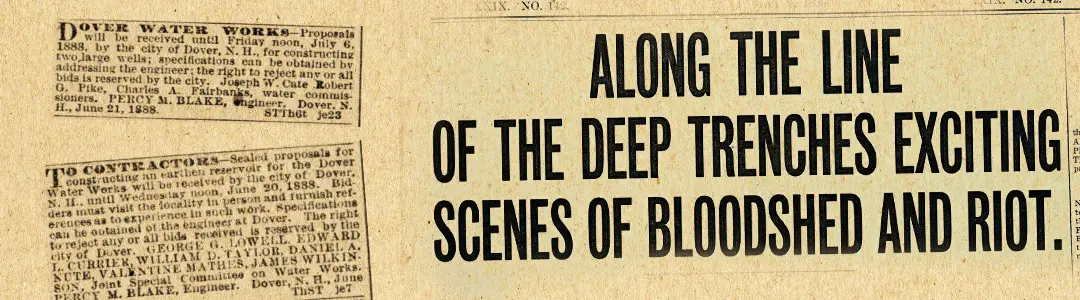
Not all of the information previously mentioned appears to be 100% accurate. There is an extended article in the Dover Daily Republican of June 21, which begins: “As near as we can gather the facts of the case …,” and this seems to offer a more complete picture of what occurred. (We’re relying on the Dover Daily Republican because, for some unexplained reason, there are no microfilm records of Foster’s Daily Democrat for the year 1888. You might think it strange that there are two daily newspapers for a town that, at the time, had a population of around 12,000, but there was a very clear distinction between the two in terms of political party support.) The headline on June 21 is the following: “Along the Line of the Deep Trenches Exciting Scenes of Bloodshed and Riot.” There’s no indication of who the reporter might be, but there is clearly an attempt to get the full story.
There had been trouble brewing between Lorenzo Smith and the workers since the previous day. Smith “had made himself obnoxious … by his domineering and severe treatment.” All of this had been verbal until Michael Russo, “an Italian sub or section boss,” was discharged. Workers then refused to work unless he was reinstated. Dacey was notified, and he reversed Smith’s order. Smith took issue with this and, possibly “under the influence of intoxicants,” the level of his abuse increased.
At the start of the next day’s work, around 7:30 a.m., Smith “paraded down the line of men excavating on Fifth Street and on some pretext discharged two of the numbers.” Near the residence of Ralph Hough he had an “abusive tirade” with another worker, who responded by leaping from the trench “in an angry frame of mind.” Smith produced a revolver, which prompted others to drop their work. Smith “fired point blank” in the direction of this group, and “several of the shots took effect.” “Instantly a scene of frantic disorder and riot ensued.” Smith had been seated “in Mr. Samuel Hull’s team, Mr. Hull holding the reins.” As the crowd approached he took off in the direction of Sixth Street and was able to distance himself—and Smith—from those following on foot. One description from the reporter: “The rage of the Italians cannot be described. Their dark, swarthy countenances wore a deeper and more forbidding cast, while fire seemed to flash from their dark and threatening eyes … No attempt was made, however, to wreak their vengeance upon anyone not immediately connected to the affair.”
It happened that a local mail carrier, Charles E. Clark, was in the immediate area of the confrontation and was able to describe the event. He went to the aid of anyone who might have been struck. “Seeing a lad crying nearby, he approached” and found that he had been struck by a bullet in the chest. This turned out to be Dexter Priestly, whose home was at the corner of Fifth and Grove streets. Mr. F.H. Pease, the principal of the Sawyer School (the building is still there; now apartments), directed a young man to notify Priestly’s father, who worked at Wessenger’s carriage shop on New York Street. Mr. Dacey happened on the scene and notice was sent out for a doctor. Both Dr. Sullivan and Dr. O’Donovan appeared. Special Officer Shapleigh was directed to keep a gathering crowd from “entering the premises.”
At this point all work on the project had stopped. One of the workers, identified as Franco Malta, came forward with a gunshot wound to “the muscles of his left arm.” He was taken to the Priestly house where “surgical aid was given to him.” The paper reported that “the stoicism of Malta under the circumstances was remarkable.” “In another quarter, Mr. Collins, who had charge of the filling-in gang, had been attacked by the Italians and was thought to be severely injured in the arm, back and breast.” He had sought shelter in the Mitchell residence on Grove Street and had been escorted by officers Otis and Willand “from the scene and placed under surgical care.”
Collins gave a description of his confrontation, jumping a fence and going into a nearby residence. “The lady of the house” pointed to the rear exit, which he took, but several men continued the pursuit until he got to the Mitchell house, where Mrs. Mitchell was cooking in the kitchen. She and Mr. Mitchell covered him with bed clothes in an upstairs room, and the police were notified. The report stated that as the officers helped him from the scene he was met with “grimaces and gestures indicative of future vengeance … the most suggestive being the drawing of the fore finger across the throat.” Two witnesses came forward to say that it appeared that Collins had been attacked without provocation, and he had fired his revolver in self-defense, apparently not directing any shots directly at any individual.
Smith’s version of the event was that approximately 6:30, before he had had a chance for breakfast, he had words with several of the workers and fired three of them. He told them to go to the company office to get whatever wages were due. The last to be discharged demanded that Smith pay him then and there and they had an argument. He was followed to the point of Hull’s wagon, where he was struck in the side with a shovel. The Italian “uttered some sort of a war cry” and the trenches emptied. He fired his gun in self-defense and Hull took off toward Sixth Street and then to Horne’s Hill.
(to be continued)
Read Part 3 here.
Visit the Crimes Along the Cochecho for all stories released so far.
Anthony McManus is a Dover, New Hampshire historian whose column “Crimes Along the Cochecho” explores the darker chapters of local history. A Dover native and Boston College Law School graduate, McManus served as City Attorney for Dover (1967-1973) and held various public offices before practicing law until 2001. His extensive historical work includes the “Historically Speaking” column in Foster’s Daily Democrat and his 2023 book “Dover: Stories of Our Past,” released for the city’s 400th anniversary. Through research, writing, and public presentations, McManus continues to illuminate both significant events and lesser-known stories that enrich understanding of Dover’s colorful past.