
Missed Parts 1 and 2? Start here first.
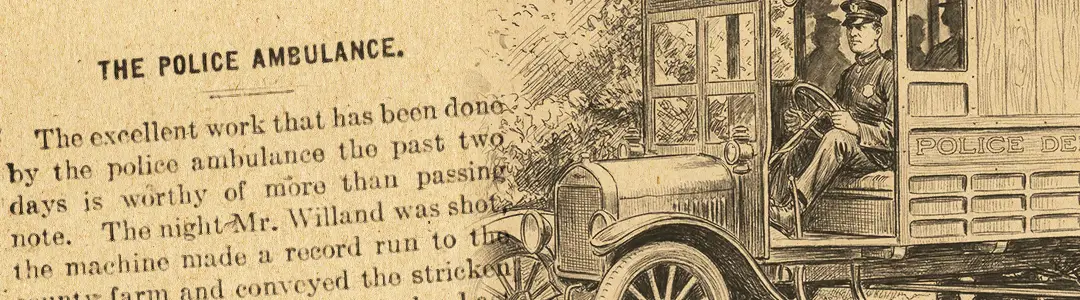
In the same edition of Foster’s, July 10, 1915, there is an article — maybe, more accurately, an editorial — extolling the virtues of Dover’s ambulance. Pointing out that on the night Willand was shot, “the machine made a record run to the county farm and conveyed the stricken man to the Wentworth Hospital.” Then, at 11 p.m., there was a call to the station, and another call for the ambulance, and “all speed laws were disregarded” as compared to the “former horse-drawn vehicle.” Mr. Carver, the driver, is to be given considerable credit. The article then refers to the fact that “a foolish injunction still prevents the police from driving the ambulance themselves.” (Mr. Carver, you may recall, an employee of McShane’s Garage, was one of the witnesses to testify in the Leo Maloney case.) {Without doing a great deal of research on this point, it appears that there was a dispute between the police department and the City Council and/or the Police Commission, the latter questioning the cost of maintaining a city ambulance, to the point of filing for a court order that a department-owned vehicle not be allowed. Hence, the ongoing arrangement with McShane’s.}
Back to our story. In Mr. Willand’s absence, the county commissioners took turns in administering the affairs of the farm, Mr. Scruton one day, Mr. Ham the next. A number of people came forward expressing an interest in the now vacant position. Official business, including the regularly scheduled commissioners’ meeting, was postponed. On the 12th, it was noted that Mrs. Willand was “holding her own with a chance for recovery,” although still on the danger list at the hospital.
Also on the 12th was Mr. Willand’s funeral. Prior to the church service at the First Methodist Church in Rochester, there were prayers at the Dover residence of one of the Willand daughters, Mrs. E.B. Folsom. There was a large attendance at the church, including 100 members from the Masons, members of the Cocheco Grange, Eastern New Hampshire Pomona Grange, many prominent county, city and town officials, and “hosts of friends and relatives.” The ceremony was opened by the Rev. Joseph Simpson, pastor of the church. The Masonic Male Quartet rendered three selections during the service. The Rev. Leon J. Morse, pastor of St. John’s Church of Dover, “where the decedent attended and assisted in the services,” was the officiating clergyman. “The impressive Masonic burial ritual was performed and remains conveyed to Rochester Cemetery, bearers were County Commissioners J.B. Young, Edgar J. Ham and Lewis Scruton, assisted by five former commissioners.
The news on the 17th was not good. Mrs. Willand passed away at the hospital, age 66. Following her fall she had “seemed to improve slightly, but yesterday she began to fail, and it was then quite apparent that the end was near at hand.” According to the paper, “she was a superior woman, with an intellect that was clear and comprehensive … above all else, pure, sincere, and noble.” Her funeral took place on the 19th at the home of her daughter, Mrs. Ernest Folsom. Again, the Rev. Morse officiated, and the three commissioners served as pallbearers, along with Thomas Tolmay, the janitor at the county courthouse. The reporter noted a “large and magnificent floral tribute.” Her burial was in the Rochester Cemetery, “… beside the remains of her husband.” Two ceremonies a week apart.
Which brings us to September. The grand jury met on the 14th to review a number of cases, including that of Rhody Merchant. An indictment of first-degree murder was handed down, and on Friday the 17th, his attorney — he had decided to obtain legal counsel — W.W. Scott, asked that any arraignment be postponed to allow him to better familiarize himself with the case. That request was granted by Dover’s own John Kivel, now elevated to the Superior Court bench. The trial was originally scheduled to begin on Oct. 18: “the date has been arranged to accommodate attorney General Tuttle, whose presence here before that time as prosecuting attorney will be impossible.” (In the midst of all of the court activity, there is actually some good news earlier in the week. On the 13th, “RED SOX WIN WORLD’S SERIES.”)
But then a notice that the Merchant case would be postponed yet again, this time to begin on Nov. 22. A request was sent to ward clerks throughout the county for the selection of “special jurors” for that date, resulting in a total jury pool of 74 individuals (still limited to men). Because of a conflict with an ongoing trial, the case was again postponed to the 29th, but that never happened, because Merchant did appear before the court on the 22nd and entered a plea of guilty to a charge of manslaughter in the first degree. (There is an interesting short piece in the paper on the 21st: “There was a great demand for the Weekly Democrat last week containing a complete account of the tragedy at the County Farm. So great was the demand that we printed a second edition.” Obviously, a great deal of interest in the case. Merchant’s decision to plead out thereby deprived Foster’s of any opportunity to go to press with the story of what would likely have been a very dramatic trial.)
(to be continued)
Read Part 4 here.
Want to know when the next article is published? Sign up to be notified here.
Visit the Crimes Along the Cochecho for all stories released so far.
Anthony McManus is a Dover, New Hampshire historian whose column “Crimes Along the Cochecho” explores the darker chapters of local history. A Dover native and Boston College Law School graduate, McManus served as City Attorney for Dover (1967-1973) and held various public offices before practicing law until 2001. His extensive historical work includes the “Historically Speaking” column in Foster’s Daily Democrat and his 2023 book “Dover: Stories of Our Past,” released for the city’s 400th anniversary. Through research, writing, and public presentations, McManus continues to illuminate both significant events and lesser-known stories that enrich understanding of Dover’s colorful past.