
Missed Part 1? Read it here first.
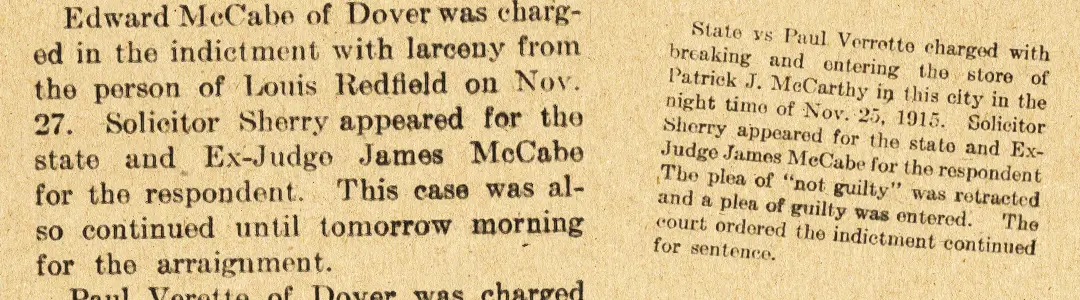
On Feb. 3, 1916, Edward A. McCabe was arraigned in Superior Court and entered a plea of not guilty. On the 16th he returned and pleaded nolo — he is not contesting the charge — and he is sentenced to eight months in jail, with a mittimus to issue at the call of the county solicitor. (Foster’s reports a plea of “guilty”, but the court record says “nolo”.) That means that as long as he keeps out of further trouble he serves no time.
Robert Ainsworth is arraigned on Feb. 16, and he enters a plea of guilty. The charge, however, is not the claim of assaulting and robbing Redfield. The indictment in question alleges that on Nov. 25, 1915, “about the hour of 7 in the night-time” he and two others broke into the saloon of Patrick McCarthy, which was located at 79 Main St., and “did steal, take and carry away one quart of whiskey, the value of one dollar, one hundred pieces of the lawful nickel coin of the United States called nickels”, and an additional varied number of dimes, quarters and half dollars. There is an indictment for the assault and robbery of Redfield, but there is no plea, no sentence, no marking of any kind. He is sentenced, on the McCarthy indictment, to one year in jail, plus costs. And in his case he serves his sentence, and he serves it in full, because on Feb. 17 of the following year, 1917, he files a petition asking to be released from further imprisonment because he is unable to pay any of the costs assessed. The request is granted by Dover’s Judge Kivel.
Also on Feb. 16 is the case of a Paul Verrette. As noted above, Robert Ainsworth had been arrested in Providence and returned to Dover to face charges. Once here, he provided information regarding the Redfield matter, and also “It appears that the arrest of Robert Ainsworth cleared up the break at McCarty’s saloon which the officers have been trying to solve”. He admitted his role in the event, identified Joseph Gingras as a participant and named Verrette as the person who had planned the break-in. Ainsworth said that he had been present but denied that he had actively participated in the theft of the money and the bottle of whiskey. With this information in hand, a complaint was sworn out for Verrette’s arrest. On the morning of Jan. 10, Capt. Murray appeared at Pacific Mills No. 1, where Verrette was employed, and placed him under arrest.
Verrette is represented at the Superior Court by Attorney McCabe, and he is arraigned on Feb. 3 with a plea of not guilty. On the 16th, he appears along with Edward McCabe and Robert Ainsworth, retracts his earlier plea and enters a plea of guilty. Judge Kivel continues the case for sentence. As in the case of Edward McCabe, if he keeps his nose clean there will be no jail time. This does not happen, however. On the 2nd day of August 1917, Verrette does a B&E at the dwelling house of William Mitchell, located in Barrington, during which he made away with $66 in cash. He is later apprehended. On Sept. 13, 1917, he appears before the Superior Court and enters a plea of guilty to the Mitchell offense. That case is continued for sentence, but a mittimus is issued with regard to the McCarthy saloon break-in, and he is ordered to serve six months in the county jail.
(to be continued)
Read Part 3 here.
Visit the Crimes Along the Cochecho for all stories released so far.
Anthony McManus is a Dover, New Hampshire historian whose column “Crimes Along the Cochecho” explores the darker chapters of local history. A Dover native and Boston College Law School graduate, McManus served as City Attorney for Dover (1967-1973) and held various public offices before practicing law until 2001. His extensive historical work includes the “Historically Speaking” column in Foster’s Daily Democrat and his 2023 book “Dover: Stories of Our Past,” released for the city’s 400th anniversary. Through research, writing, and public presentations, McManus continues to illuminate both significant events and lesser-known stories that enrich understanding of Dover’s colorful past.