
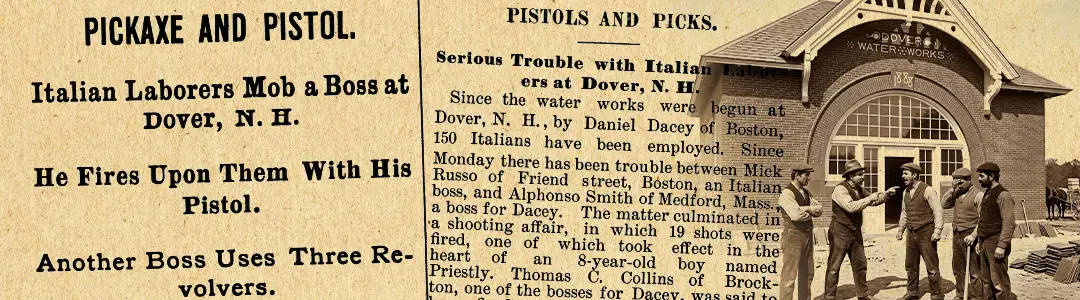
You may have seen a recent news article about the approval of a grant from the NH L-CHIP program toward the cost of restoring the buildings of Dover’s water works located at the end of Lowell Avenue.
In a special election held on Nov. 30, 1887, by a count of 1,326-346, local voters approved a bond for the construction of a municipal water works system. Up to that point, there had been several separate private companies providing limited service. Money from the bond was used to purchase these agencies, plus a portion of Garrison Hill, allowing construction of a reservoir, which would be completed in November 1888. In the meantime, a contract had been signed to build a central pumping station and related equipment, two wells, and a series of pipes connecting the system to the wells, the station, and piping throughout the community. The mayor at the time was George G. Lowell, hence the name of Lowell Avenue, which provided access to the new building. The contract for most of this work was with a William Dacey from Boston, and he began the project on June 11, “with a crew of 150 Italians.” And so our story begins.
It didn’t take long for things to fall apart. Within one week, there was “trouble between Michael Russo, an Italian boss, and Lorenzo Smith, Dacey’s boss.” Two days later, Russo was fired, and his crew walked off the job, insisting that he be rehired. Dacey, the contractor, agreed. Smith was unhappy with this outcome and began to “boss the workmen in a very arbitrary way and discharged two of them,” but shortly thereafter, according to news reports (this one from the Alexandria, Virginia, Gazette) “at a given signal the Italians jumped from their trenches and rushed for Smith, one of them, named Bard, striking him with a pick handle.” It went downhill from there.
“Pistols and Picks. Serious Trouble With Italian Laborers at Dover, N.H.” (This headline from the Essex County Herald of Guildhall, Vermont.) Smith came up with a gun, fired into the gathered workers, and wounded one of the workmen. But an 8-year-old, the son of J.H. Priestly, who happened to be in the area at the time, was also wounded. First reports were that he was unlikely to recover. A local paper, the Daily Republican, reported that the boy’s parents resided on Fifth Street, and the wound was to the stomach, “from which it is thought the boy will die.”
Smith jumped into a nearby wagon and was driven off, “followed by fifty infuriated Italians.” He managed to escape, but the crowd turned toward another of Dacey’s bosses, Thomas Collins. Collins, who was also armed, fired a number of shots, but this time no one was hit. One of the workers, however, got close enough to strike him with a pick, reportedly breaking an arm. He was able to leave the area without further injury and took refuge in a nearby house.
In the meantime, the police had been notified, and upon their arrival found that things had quieted down. Smith was said to have “jumped from the wagon, swam the river, and ran into the town,” where he was taken into custody and charged with the shooting, which he claimed was in self-defense. Collins was also placed under arrest, as it was claimed by some that it was one of his shots that struck the Priestly boy. Back at the construction site, tempers had cooled, but the employees were refusing to return to work. By early afternoon, however, work was resumed and “quiet prevailed along the line.” One report noted that “the prompt and efficient work of Marshall Fogarty and his corps of officers cannot be too highly commended,” and further that “Smith and Collins are lodged in jail so that they may be protected from the Italians and have justice done them.”
(to be continued)
Read Part 2 here.
Visit the Crimes Along the Cochecho for all stories released so far.
Anthony McManus is a Dover, New Hampshire historian whose column “Crimes Along the Cochecho” explores the darker chapters of local history. A Dover native and Boston College Law School graduate, McManus served as City Attorney for Dover (1967-1973) and held various public offices before practicing law until 2001. His extensive historical work includes the “Historically Speaking” column in Foster’s Daily Democrat and his 2023 book “Dover: Stories of Our Past,” released for the city’s 400th anniversary. Through research, writing, and public presentations, McManus continues to illuminate both significant events and lesser-known stories that enrich understanding of Dover’s colorful past.