
Missed the previous installments? Start here.
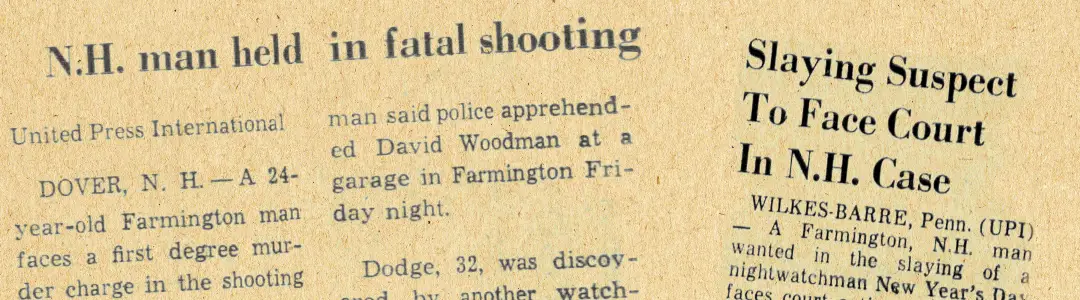
Shortly after 7, Spaloss and several officers came to the Woodman residence with the search warrant. Fisher had arrived, and he accompanied the group into the basement. Newhall took photos of the interior as others searched. Heon, quite likely the smallest of those present, entered the crawl space and eventually observed a paper bag in an area behind the chimney. This contained a blue plastic wrapper and a revolver, in a holster, with what appeared to be a number of .22-caliber bullets. More photos were taken of the contents of the bag. Outside of the house, it was examined in detail, identification information taken down, and then everything was turned over to Inspector Rowe. Back at the Farmington PD, Inspector Redden had a brief conversation with David Woodman, who made a comment to the effect that “he sawed that gun up.” He said that he had destroyed it, “then he laughed and said, no, I didn’t. All I did was damage the firing pin so that it wouldn’t fire again because he killed once, and I didn’t want him to kill again.” David was placed under arrest for the murder of Robert Dodge, and an APB was issued regarding the whereabouts of Walter Woodman. At the end of the day, AG Warren Rudman (who in the future would be elected to the U.S. Senate) issued a public statement as to the progress on the case and praised the degree of cooperation between the several law enforcement agencies involved in the investigation.
Woodman is transported back to Dover by Inspector Rowe. Also in the vehicle are Inspector Redden and Deputy Sheriff Albert England. In the absence of Fisher, there is no questioning relating to the crime, but according to Rowe, Woodman volunteered several statements. One was that the bullets left in the gun following the shooting were long gone; anything they found in the bag with the weapon taken from his home were different. At some point following the incident, he had carefully wiped and oiled the gun to make sure there would be no remaining fingerprints. Finally, as recorded in Rowe’s report of the ride, he made a comment that “he hoped that the murder would be in the paper tomorrow, and a statement to the fact that 99 more and he would be as famous as Jesse James.”
Back at the Dover police station, as Woodman was being fingerprinted, he was recorded as saying that his brother had killed Dodge because “dead men tell no tales,” and a further comment to the effect that Walter might kill again because “the punishment for two was no more severe than for one.” He thought him capable of killing any law enforcement officer “that got in his way.” David also volunteered that following the murder he recalled being at work at Kidder, and on several occasions observing officers coming through, making further examinations of the crime scene.
The following morning, Saturday the 1st, he is arraigned before District Court Judge Ovila Gregoire. He is represented by attorney Lewis Fisher (the father of Robert). No plea is entered, and the case is continued to the 12th for further hearing.
(to be continued)
Read Part 11 here.
Want to know when the next article is published? Sign up here to be notified.
Visit the Crimes Along the Cochecho for all stories released so far.
Anthony McManus is a Dover, New Hampshire historian whose column “Crimes Along the Cochecho” explores the darker chapters of local history. A Dover native and Boston College Law School graduate, McManus served as City Attorney for Dover (1967-1973) and held various public offices before practicing law until 2001. His extensive historical work includes the “Historically Speaking” column in Foster’s Daily Democrat and his 2023 book “Dover: Stories of Our Past,” released for the city’s 400th anniversary. Through research, writing, and public presentations, McManus continues to illuminate both significant events and lesser-known stories that enrich understanding of Dover’s colorful past.