
Missed Parts 1 through 3? Start here first.
The four cases we have reviewed in this series — Ainsworth, McCabe, Gingras and Verrette — are interesting examples of how law enforcement and the courts may have dealt with young people during the time in question. On the face of it, the four were involved in serious criminal conduct: physical assault and robbery in the case of Redfield, breaking and entering and theft of personal property with regard to McCarthy’s saloon. From the newspaper reports (and here we venture a bit into “reading between the lines”), the injuries to Redfield turned out to be not all that serious … he was able to get up and immediately take the trolley into town to file his report of the incident, and according to the indictment, the proceeds of the robbery amounted to the grand total of $2.50. Finally, chances are good that Mr. McCarthy ended up being reimbursed for whatever financial loss he may have suffered.
Beyond that, it would seem that all four were relatively young, late teens perhaps, maybe early 20s, and there was no indication that any of them had been in trouble previously. McCabe’s story of being sick at home following the attack on Redfield might not be quite accurate, but there’s no question that he showed up at the police department voluntarily, turned himself in and cooperated. Ainsworth didn’t do that, but it’s clear that when he was arrested in Providence he was in the process of enlisting in the military, which could have been seen as an attempt to turn his life around.
Although well after the fact, Gingras also turned himself in and apparently cooperated with the authorities from that point on. Verrette didn’t come forward as did the others, but he never left town and appeared to be holding down a full-time job. It may also have been a plus that all four were represented by well-connected local attorneys, and for some of the time, at least, the judges overseeing the cases in Superior Court were two Dover natives, Robert Pike and John Kivel. (It’s also interesting that several reputable local citizens stepped forward to offer security for the bail imposed following the arrest of at least two of the young men.)
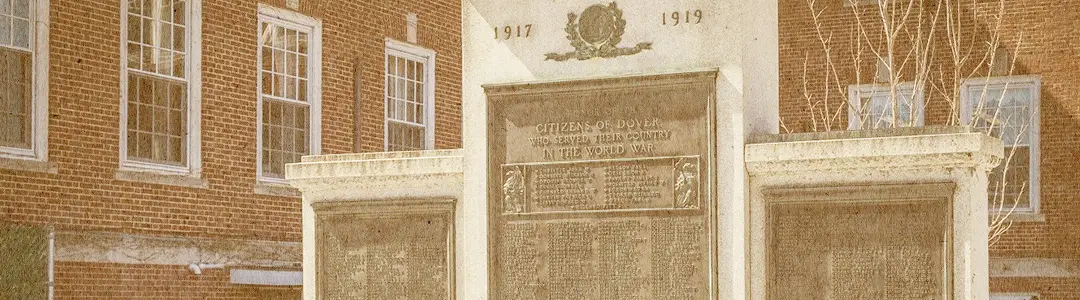
The end result here was that, despite the seriousness of the charges, felonies all around, all of the individuals, in large part, were given a break: no jail time at all for McCabe, Gingras, and Verrette — at least until the latter blew his chances the second time around. There is the possibility that there was some incentive, however. It was not unheard of — even up to more modern times — that severe penalties for some young offenders were traded off for a promise to go into military service. This may have been the case with at least two of our subjects. While there is no immediate record of what may have happened as to the future of Gingras and Verrette, the World War I Memorial in front of Dover’s City Hall may give us a clue as to the other two. This monument shows the names of both Robert Owen Ainsworth and Edward A. McCabe, and McCabe is reported to have remained in the U.S. Navy, at least as late as 1921, with a local address of 34 Second St. They both did their duty and survived.
Finally — and the following is not in itself a true crime story, but is related to one of our earlier events — and is, by itself, an interesting part of Dover’s past. The World War I Memorial also celebrates the name of William H. Dobbins, who was the brother of Thomas Dobbins, and readers of these tales may recall that Thomas was one of the victims of the John Williams rampage on Main Street on July 4, 1900. Unfortunately, William is not in the same category as Ainsworth and McCabe. According to the record, he almost made it through the war unscathed. It wasn’t until November 1918 (the Armistice was on the 11th) that he was first listed as “missing in action”. A death notice issued the following month, however, revealed that he died on Oct. 4. His exact burial site — somewhere in France — is unknown.
There is a second memorial to William Dobbins, a small stone on a small island at the junction of St. John Street and Broadway, an area designated, for a time in the past, as Dobbins Square.
Visit the Crimes Along the Cochecho for all stories released so far.
Anthony McManus is a Dover, New Hampshire historian whose column “Crimes Along the Cochecho” explores the darker chapters of local history. A Dover native and Boston College Law School graduate, McManus served as City Attorney for Dover (1967-1973) and held various public offices before practicing law until 2001. His extensive historical work includes the “Historically Speaking” column in Foster’s Daily Democrat and his 2023 book “Dover: Stories of Our Past,” released for the city’s 400th anniversary. Through research, writing, and public presentations, McManus continues to illuminate both significant events and lesser-known stories that enrich understanding of Dover’s colorful past.