
Missed the previous installments? Start here.
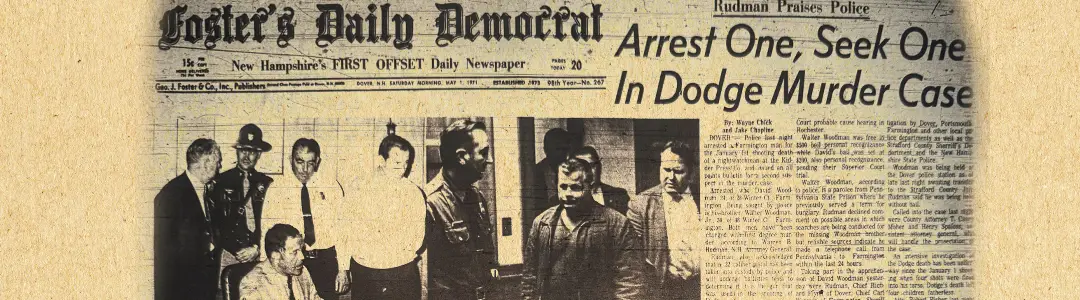
Despite the hours of investigation described above, involving a number of people from multiple police agencies, there was little progress over the next three months, leading up to the end of April. But then, there is a flurry of activity. Much of the initial public information appears in a front-page story on April 30, which even merits a byline, still unusual for Foster’s, attributing the reporting to Wayne Chick and Jake Chapline. It’s not exactly clear from the record how all of this came about, but on the 27th, State Trooper Martin Heon received information from an unidentified source implicating two brothers from Farmington, Walter and David Woodman. Inspector Rowe also received a tip around the same time to talk to Bruce Roy, an inmate at the Strafford County House of Correction. Then on the 30th, Farmington Chief of Police Carl Worster was contacted by someone at the Strafford County jail, who may or may not have been Roy, who said he was “wanting to talk.” Both Walter and David had been held at the jail for a short period of time previously, following their arrest for an alleged burglary unrelated to the Dodge case. They both had been released on bail prior to the tips being passed on to Heon and Rowe.
Worster notified State Trooper John Newhall, and about noon on the 30th, they met with the (unnamed) person, in the presence of his girlfriend and his attorney. This person related that on April 19 he had been with Walter Woodman, who lived in Farmington, and Walter had told him of his participation in a burglary at the Ajax Garage in that town, the theft of a number of chainsaws and the subsequent sale of those items in Salem, New Hampshire, to a man named Mike. Woodman said that his brother, David, had been with him during the break-in. He also related that he had “shot a guy” for $217, and that David had been present, and that the man had known David, who, after he had been shot, had covered him with a blanket. There is also a record of a statement attributed to Bruce Roy, in which he related having an argument with one of the Woodman brothers — confirmed later to be Walter — where he was threatened “just like they shot the watchman at Kidder Press.”
With this information in hand, the attorney general’s office was notified, and both AG Warren Rudman and Deputy AG Henry Spaloss traveled to Farmington to review the information. Spaloss assisted in drafting an application for a search warrant of David’s home, which was located on Winter Street. Arrangements were made to present the request to Farmington Municipal Court Judge Eugene Nute, and after a hearing and review of the information above (Nute’s handwritten notes are part of the still-existing file), the petition was granted. Dover Inspectors Rowe and Redden had been notified, and they traveled to Farmington to assist in the search. Later in the afternoon, State Trooper Martin Heon, who apparently had been involved in the Ajax Garage investigation, received a call from Worster relaying a statement that David had given regarding his participation in that incident. When Heon arrived shortly after 5, he was directed to go to David’s residence to make certain no one entered or left pending receipt of the search warrant. Accompanied by Farmington Officer Gene Reed and Strafford Deputy Sheriff Robert Keniston, they checked the exterior of the building, then knocked, and determined that no one was home.
While Spaloss and the others were pursuing the search warrant for the Woodman residence, Worster and Newhall had gone to the Ajax Garage, where David Woodman was an employee, and brought him to the Farmington PD for questioning. They advised him of the information they had received from the individual at the jail and asked if he had any information about any other burglaries in the area. Woodman said he didn’t. They told him they were interested in a separate break-in where a gun had been stolen. Woodman said he had no information. He was then advised of his rights and was told that they believed that the gun in question could be found at his residence. Again, Woodman said he knew nothing about it. They said that they had reason to believe that the gun had been used in another crime, and if it had, and he had it, “they wanted him to really think about this…and you know what we mean, and he said you mean Dodge and we said yes, that’s correct — Dodge.”
David then provided a full statement. “We just walked up and rang the bell and told Dodge we had forgotten something” — at the time of the murder, David was employed as a janitor at Kidder Press — Dodge let him in, along with Walter, and within a very short time Walter fired at Dodge, who turned to David, saying, “Help me, Help me” and “Walter continue to fire and Dodge went down.” They then went to the area of the snack room and broke into the coin machine, though they had a hard time doing it, using several tools from a neighboring work area. Taking what money they could, they left the building. At some point, David had gone to a side room and taken a blanket, which he used to cover the body. The two had hitchhiked from Farmington, so they took keys from Dodge’s person and drove his car to Portsmouth, parked it, and, David said, they then hitchhiked back to Farmington. They had disposed of the keys outside of where they left the car — in the High Hanover Parking Garage — and David drew a diagram as to where the keys might be found. (That information was promptly relayed to the Portsmouth PD. Detective William Mortimer organized a search party. Following David’s description, they went to a parking lot next to the movie theater on Market Square. The keys and Dodge’s missing leather strap were located and hand-delivered to the Dover department that same evening.)
At some point during the course of David Woodman’s questioning, he was joined by his wife, Kathy. In her presence, he was again advised of his rights, and they both felt it would be in his interest to talk to a lawyer. David said he had been represented in the past by attorney Robert Temple of Dover, so a phone call was made to his office. Robert Fisher, another attorney in that office, took the call and, after a brief conversation with Woodman, advised him not to make any further statements. Fisher said he would be coming to Farmington.
(to be continued)
Read Part 10 here.
Want to know when the next article is published? Sign up here to be notified.
Visit the Crimes Along the Cochecho for all stories released so far.
Anthony McManus is a Dover, New Hampshire historian whose column “Crimes Along the Cochecho” explores the darker chapters of local history. A Dover native and Boston College Law School graduate, McManus served as City Attorney for Dover (1967-1973) and held various public offices before practicing law until 2001. His extensive historical work includes the “Historically Speaking” column in Foster’s Daily Democrat and his 2023 book “Dover: Stories of Our Past,” released for the city’s 400th anniversary. Through research, writing, and public presentations, McManus continues to illuminate both significant events and lesser-known stories that enrich understanding of Dover’s colorful past.